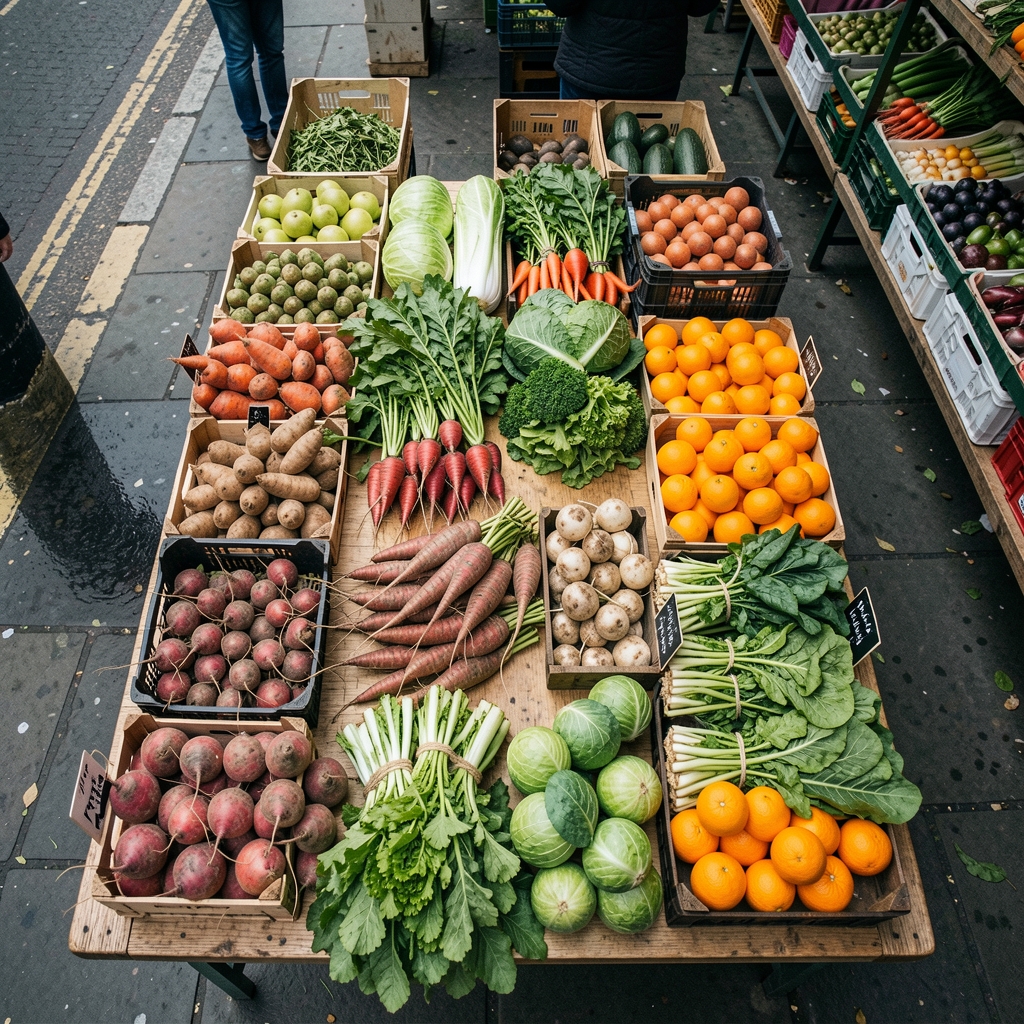
London, February 2026 — The notebook that sits open on the kitchen counter is not a regimen. It records what was purchased at the market each Saturday, what was prepared on Sunday afternoon, and what, in practice, was consumed across the following five days. Twelve weeks of such entries constitute the source material for what follows.
Week One: The Inventory Problem
The first observation — noted in the third entry — is that the kitchen contains far more than is required for a single week's eating. Tins of pulses, jars of preserved grains, half-used condiments and forgotten cereals occupy four shelves and the back of a cupboard. The act of cataloguing this inventory takes most of Sunday morning. What emerges is not abundance so much as accumulation: a physical record of previous intentions, many of them abandoned.
A nutrition writer of some years' acquaintance — not a contributor to this journal but a familiar colleague — has described this phenomenon as "the larder gap." The gap between what one intends to eat and what one in fact consumes, documented in the space between purchase and disposal. Most households, she has noted, could sustain a week of nutritionally considered eating without a single trip to market, purely from what already sits in their cupboards. The evidence in this kitchen, at least, supports that observation.
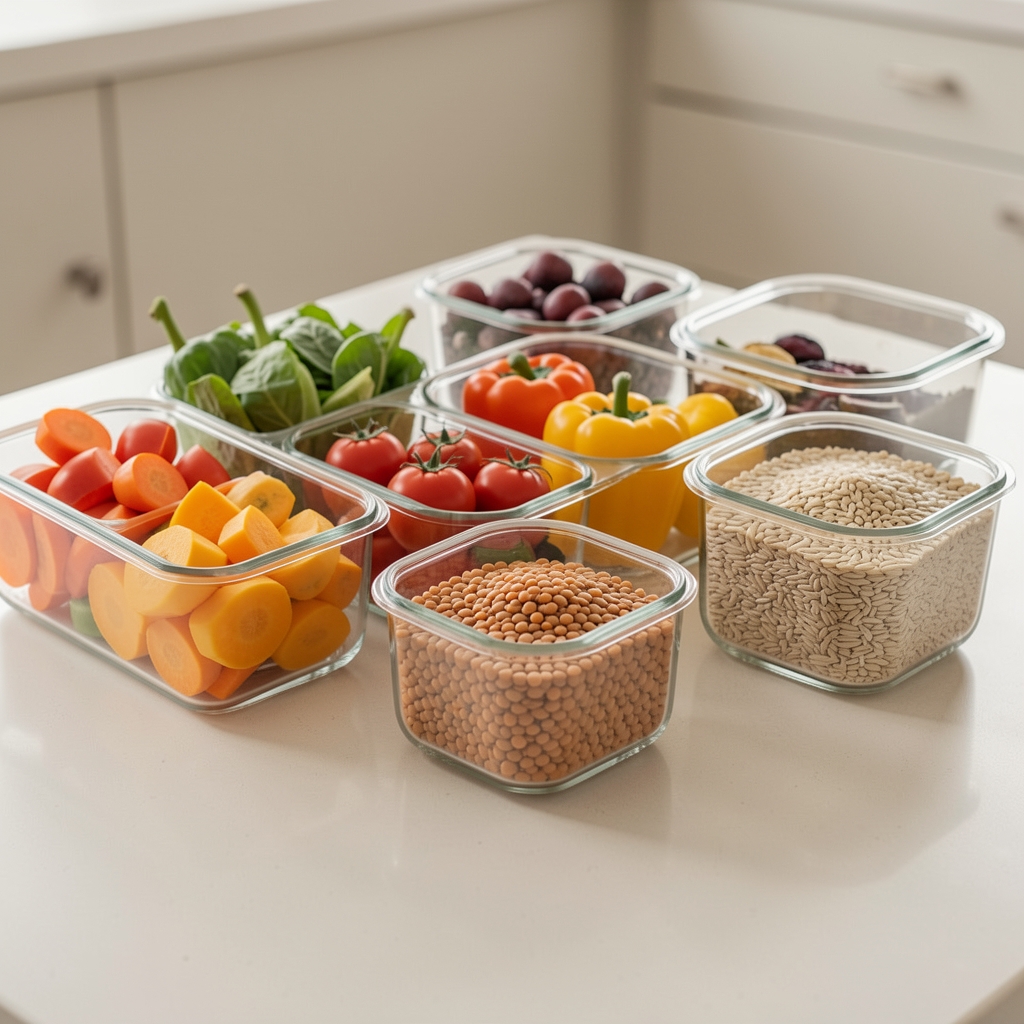
The first week's meal planning begins, therefore, not with acquisition but with audit. Lentils, dried chickpeas, a jar of white beans, oats, barley, and three varieties of rice are lined along the counter. Alongside them: a half-dozen winter vegetables from the previous week's market run — swede, celeriac, two large parsnips, and a bundle of cavolo nero. This is the starting inventory. What gets eaten from it over seven days is the first data point.

The Shape of a Balanced Day
The question of what constitutes a balanced meal is, in practice, less abstract than nutritional theory suggests. Published research — from long-running institutional studies rather than short-term interventional work — points consistently toward a pattern rather than a formula: a substantial proportion of the daily plate occupied by vegetables and fruits, a moderate allocation of whole grains and legumes, a smaller fraction of protein-dense foods, and an accompaniment of adequate water and oil from whole sources. This is not new information. The difficulty is not knowledge but execution across seven consecutive days, in the context of ordinary working life.
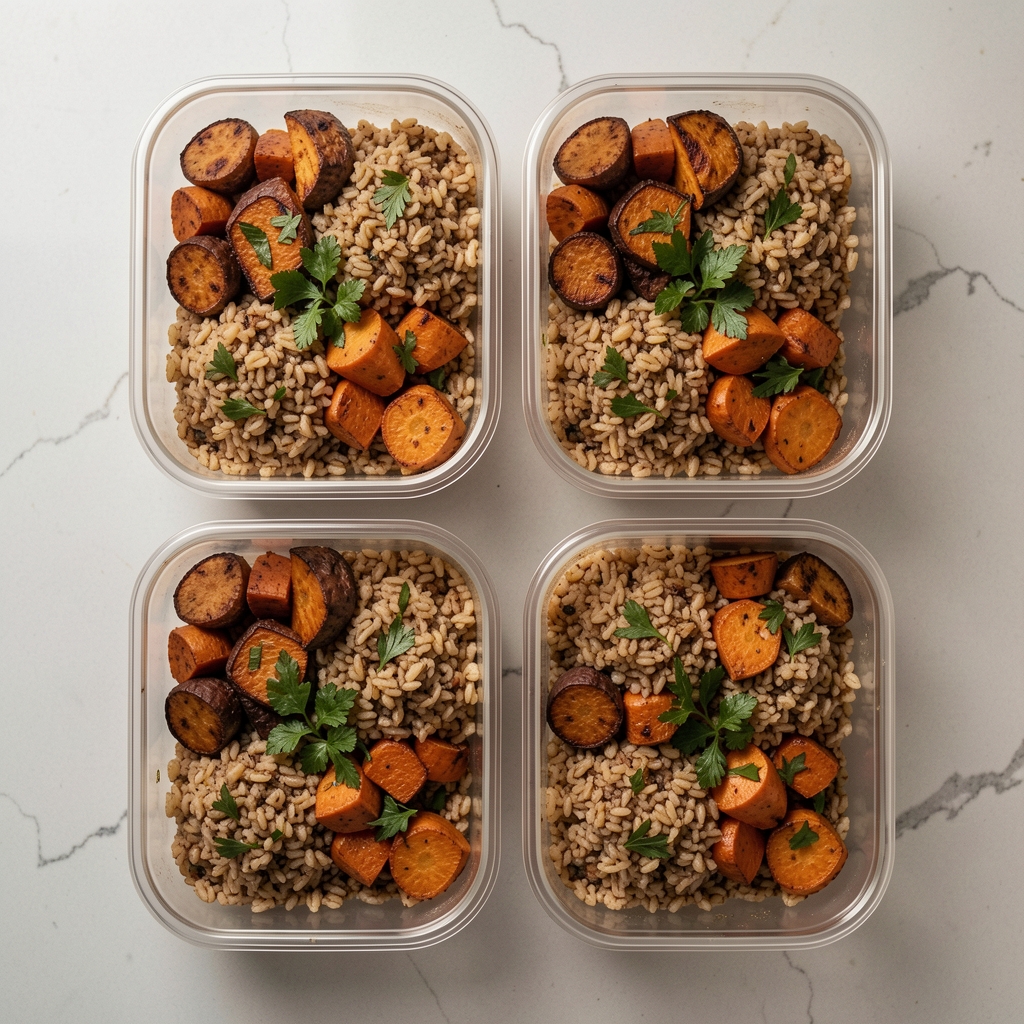
What the notebook records, across its first three weeks, is a steady drift from the intended pattern by mid-week. Mondays and Tuesdays tend toward the planned composition: a grain base, roasted or steamed vegetables, a legume element, something pickled for acidity and contrast. By Wednesday the grain is often absent; by Thursday the vegetables are supplemented or replaced by whatever is quickest to prepare. This is not negligence but fatigue — the attention required to assemble a considered plate diminishes as the week advances.
The intervention noted at week four is simple: the preparation of two or three components on Sunday that can be incorporated flexibly throughout the week without significant additional effort. Cooked grains keep for four days in the refrigerator. Roasted vegetables, prepared in bulk, require only reheating. A pot of legumes, simmered on Sunday afternoon, yields enough for four to five meals. The structure does not impose a fixed menu but a repertoire of ready components from which a balanced plate can be assembled in under ten minutes on any evening.
"The notebook does not record successes and failures. It records frequency — what appeared on the plate, on how many of seven days, across how many consecutive weeks."
Portion as Observation, Not Restriction
The entry for Week Six contains a methodological note that remains, on re-reading, the clearest summary of the project's approach to portion practice. The notebook records not target quantities but observed quantities. What was served. What was eaten. What remained. The columns are not benchmarks to reach but data to consider.
This distinction matters. The available literature on attentive eating — and there is a substantial body of it, produced over several decades by researchers in nutrition science and behavioural observation — consistently identifies a gap between self-reported consumption and actual intake. The gap is not deceptive; it is structural. Portion sizes in contemporary domestic kitchens have expanded considerably over two to three generations, and what now registers as a "normal" serving of grains, oils, or refined carbohydrates often exceeds the quantities associated with stable weight management and gut function in long-running population studies.
What the notebook does not do — and this was a deliberate decision noted at the outset — is impose numerical targets. No calorie counts, no gram measurements, no rigid ratios. Instead, a set of informal anchors: does the plate contain more vegetables than any other single element? Is there a whole-grain component? Is the overall volume roughly consistent with the previous day's? These are observational prompts, not guidelines. The data they generate across twelve weeks is qualitative, not quantitative — but it is considerably more reliable than memory, and considerably less fraught than the alternative.
Active Days and the Adjustment Sequence
Three days each week are marked in the notebook as active: two mornings of cycling and one longer walk, typically on Saturday. On these days the recorded consumption is higher, both in total volume and in the proportion of carbohydrate-rich foods. This is not a managed adjustment but an observed pattern — on active days, appetite increases, and the instinct toward a more substantial grain and legume component is noted without particular significance in the early weeks.
By Week Eight, the entries begin to record a more deliberate sequence: on the evening before an active morning, the grain component of the evening meal is increased. Oats become the preferred breakfast on active mornings, often with a small amount of dried fruit and nuts — nutrient-dense foods that offer a sustained energy release across the first half of the day. Post-activity meals tend toward legume-heavy compositions: lentils with root vegetables, or a substantial bean stew prepared the previous evening. These adjustments are not drawn from a programme; they emerge from the accumulated observation of what, across eight weeks, has consistently produced the most settled and energised days.
The relationship between sport, fitness, and an attentive food practice is, in this account, not instructive. It is not that physical activity requires a particular nutritional response. It is that sustained physical activity, over weeks and months, encourages a kind of sustained attention to how one fuels the body that would otherwise remain intermittent. The notebook is, among other things, a record of that attention becoming habitual.
Gut-Friendly Recipes and the Fermentation Entry
Week Ten introduces an element not originally planned: a small programme of fermented foods, incorporated gradually into the weekly routine. Two jars of sauerkraut — one red cabbage, one white — are prepared on the Sunday of Week Nine and left on the kitchen shelf to ferment for six days. They are opened on the following Saturday and added, in small quantities, to three of the following week's lunches.
The inclusion of fermented foods in a considered daily routine is well-documented in the nutrition literature as associated with gut function and the maintenance of a diverse microbiome. The entry does not make claims beyond the observational: that the sauerkraut is consumed, that it adds acidity and textural contrast, and that its presence on the shelf constitutes a minor but recurring practice. A small jar of live-culture yoghurt joins the fermentation entries in Week Eleven; a batch of miso is purchased rather than prepared, and incorporated into soups twice in the final week.
What the gut-friendly recipe notes accumulate into, across three weeks of entries, is not a protocol but a sensibility: an attention to the microbial dimension of a considered eating practice. Fibre, fermented foods, diverse plant varieties — these appear in the notebook not as targets but as recurring observations of what constitutes a genuinely varied daily routine.
Field Notes — Key Observations
- → Sunday preparation of three to four ready components reduces mid-week drift substantially.
- → Vegetables occupy the largest fraction of every recorded plate across all twelve weeks.
- → Grain consumption increases naturally on active days without deliberate management.
- → Fermented foods — sauerkraut, live-culture yoghurt, miso — enter the routine incrementally in weeks nine to twelve.
- → The notebook is the practice. The act of recording is itself a form of attention that shapes subsequent choices.

Harriet Marsden is a London-based writer and nutrition journalist with more than a decade of experience documenting everyday food practice and active lifestyle habits. She is a founding editor of Ibron Field Notes.
More from this publication